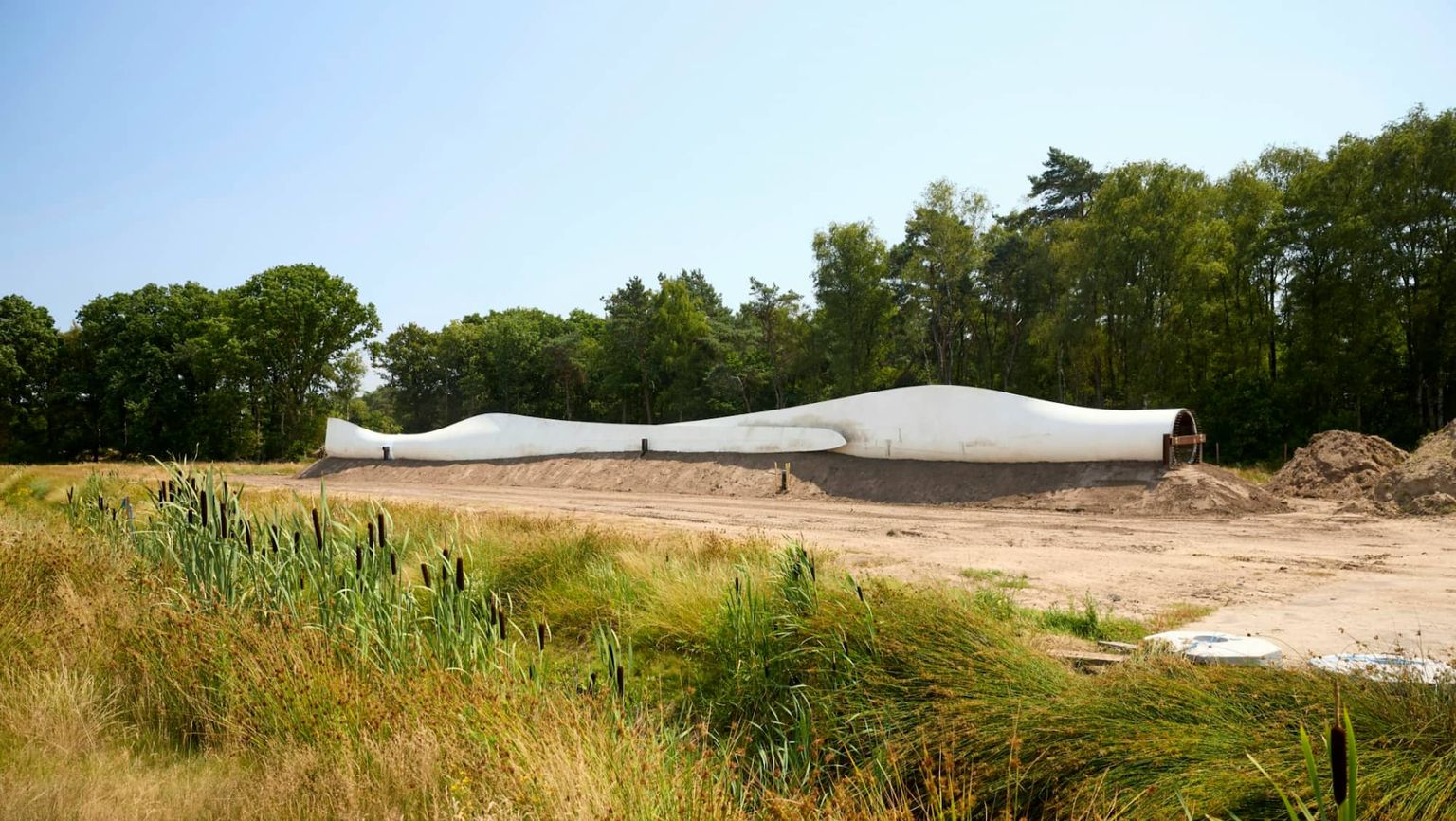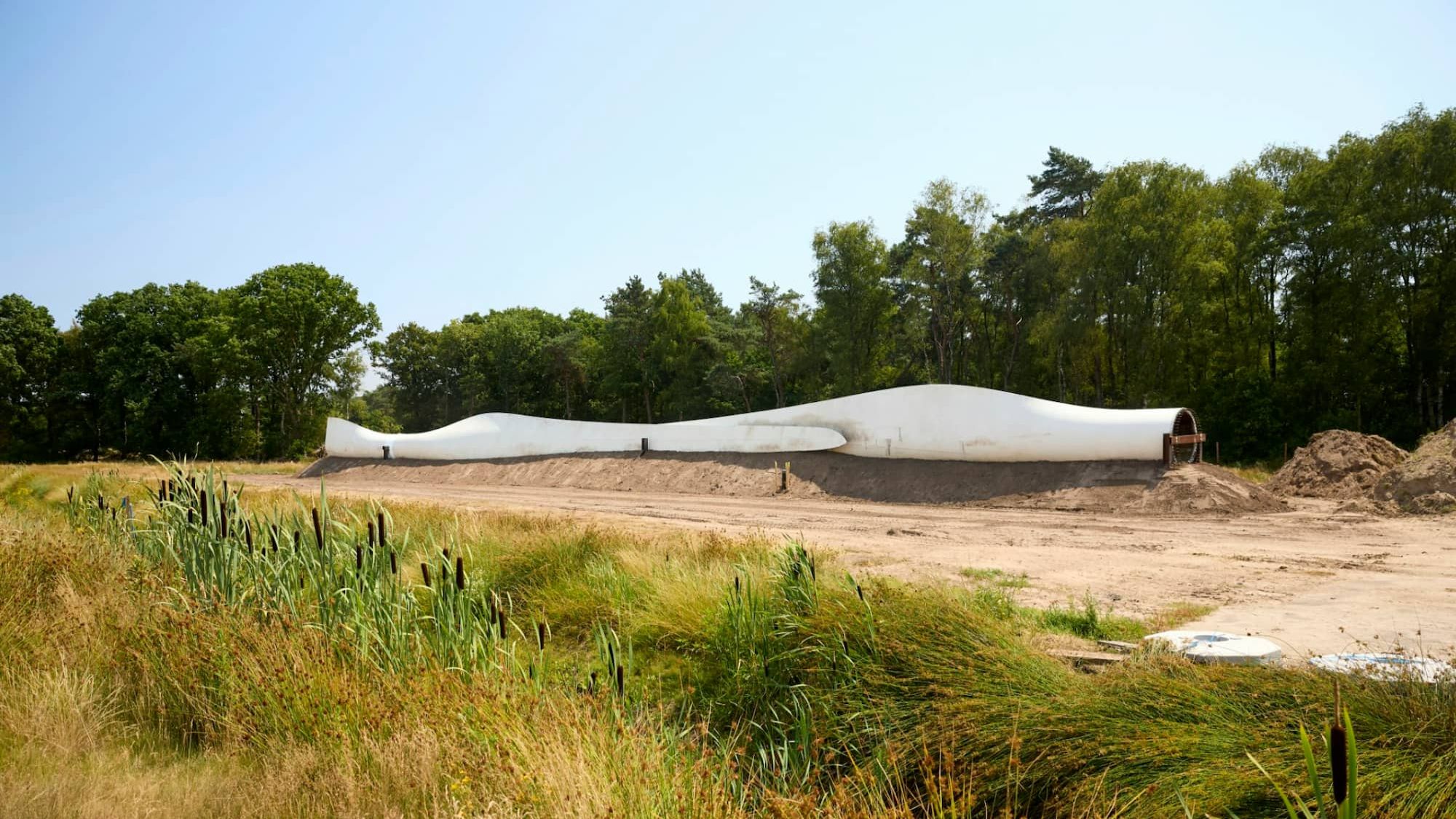
Six months after its unveiling, the Blade Barrier shows that recycled wind turbine blades can be a serious and circular alternative to traditional noise barriers.
Demcon's role
Demcon sound solutions collaborated with the company M+P on the noise research commissioned by Rijkswaterstaat. Ysbrand Wijnant, acoustic scientist at Demcon sound solutions: "We performed complex acoustic simulations and M+P translated these into a simplified model that could be used in legislation. The model calculations and measurements show that the screen, constructed from two whole turbine blades and a sawn section, achieves a noise reduction comparable to that of a traditional noise barrier approximately 3.3 meters high. This demonstrates that reused composite blades are not only structurally applicable, but also meet the acoustic requirements for highways.”
Additional criteria
These results represent an important step toward broader applicability, as the wall can now also be included in regular noise studies. In the coming period, monitoring will focus on additional criteria, such as maintenance, safety, costs, and environmental performance.
Circular alternative to waste problem
The Blade Barrier is an initiative of startup Blade-Made, which focuses on the high-quality reuse of wind turbine blades from decommissioned wind farms. Blade-Made sees the use of wind turbine blades as a solution to a growing waste problem within the energy sector. The blades are difficult to recycle and are becoming increasingly available worldwide. By using them as secondary building materials in large-scale infrastructure projects, the material remains in use for longer and the need for concrete and steel decreases. A circular alternative to this waste problem.
Ysbrand: “At Demcon Sound Solutions, we also believe this is a great project to be involved in from a social perspective. If we can great project to be involved in from a social perspective. If we can contribute to the circular economy in this way, we are more than happy to do so. Above all, it was also a special assignment, as you don’t get to work with this type of material every day.”
The test setup was realized in collaboration with Dura Vermeer, which was involved in the design and implementation. The province of Noord-Brabant also contributed financially through the Programma Circulaire Doorbraakprojecten (Circular Breakthrough Projects Program).
More information about the project can be found here (only available in Dutch):
https://www.rijkswaterstaat.nl/nieuws/archief/2026/02/hergebruikte-windturbinebladen-presteren-als-volwaardig-geluidsscherm